SLS 3D Metal Bands are printed in a premium stainless steel, and require a different cementation procedure from traditional bands.
This article focuses on bonding and cements related to 3D Metal Bands. For more information on the design options for these appliances, please reference the design article.
TABLE OF CONTENTS
- Bonding Procedure
- Mechanical vs Chemical Retention
- Cement Comparison
- Debonding Procedure
- Troubleshooting
_____________________________________________________________________________________________________________________________________
Bonding Procedure
SLS 3D Metal Bands are bonded to the tooth, much more akin to bonding a bracket than cementing a traditional band. For optimal results, we recommend the following procedure, developed with Reliance Orthodontic Products:
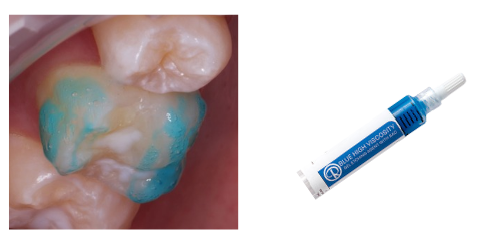 | ETCH Please note the field must be kept very dry.
|
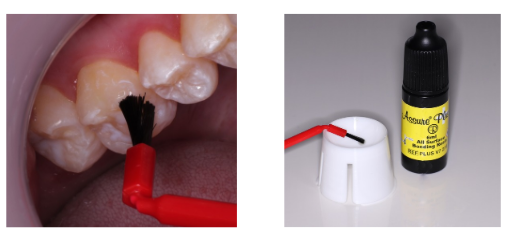 | PRIME Desiccate teeth. Apply 1 coat of Assure Plus primer to entire buccal surface and buccal cusp tips of tooth ONLY. DO NOT apply to occlusal or lingual. Air dry for 3 seconds. |
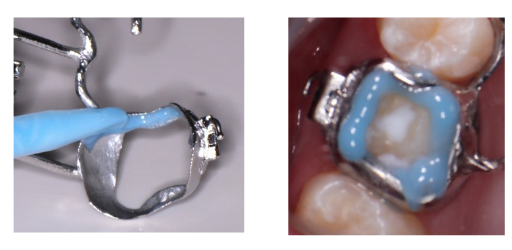 | BOND While priming teeth, apply an even layer of Self-Mix Band Lok to tooth side of appliance (dual-tube applicator). Band Lok has a 4 minute working time; do not preload appliance until ready to deliver. Seat appliance to express flash. |
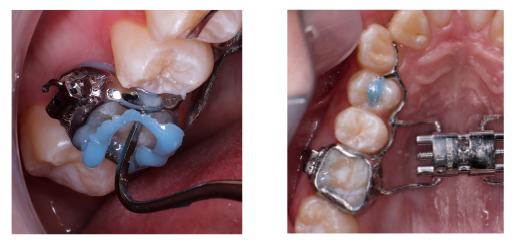 | CURE Tack cure flash for 1 second ONLY - this will make all the flash cohesive and allow for single piece removal. Finishing curing from occlusal opening for 30 seconds per involved tooth. Remove isolation and instruct patient to wait for 5 minutes for activating. Self-Mix Band Lok is a dual cure and will always achieve full polymerization. |
Mechanical vs Chemical Retention
There are two main ways in which bands are retained on teeth through orthodontic treatment - through mechanical retention and through chemical retention.
Mechanical retention includes both the fit of the band, or the "hugging" of the tooth structure and contours to hold tight, and also the micro-landscape of the bands and teeth that allow cement to hold. Seating traditional bands that are tight cause them to slightly stretch around the tooth, and provide passive tension on the tooth throughout treatment.
Chemical retention includes the bonding reactions at a molecular level that allow the cement to fuse to the band and/or tooth. On highly-etched or highly-porous bands, chemical retention can be very high, with many physical features on which cements can adhere.
Standard bands feature all three types of retention, while SLS 3D bands are missing the tight fit of the band to the tooth. This is because SLS 3D bands are designed to avoid interproximal interference, allowing us to skip the use of spacers, but requiring a different type of hold to ensure retention.
| Mechanical and Chemical Retention Summary | |||
| Type of Retention | Description | Found In | |
| Band fit on tooth | Mechanical (Macro-retention) | Physical clamping around tooth from the tight fit around tooth shape | Standard bands |
| Cement interlocking with band/tooth | Mechanical (Micro-retention) | Cement flows into microscopic irregularities and holds tight | Standard bands SLS 3D Bands |
| Cement bonding to band/tooth | Chemical | Ionic (glass ionomer) or adhesive monomer (resin) bonding | Standard bands SLS 3D Bands |
Cement Comparison
Common cements include glass ionomer and resin-based cements.
- Glass Ionomer Cements include options like 3M Ketac, Fuji I, and Fuji Ortho Band.
- Resin-Modified Glass Ionomer Cements include options like 3M RelyX and 3M Vitrebond.
- Resin Cements include options like Reliance Band-Lok and Reliance Self-Mix Band-Lok.
| Glass Ionomers vs Resin Based Cements Summary | ||
| Glass Ionomer | Resin-Based | |
| Bond to Metal | Poor chemical bond, but strong mechanical bond on rough surfaces | Strong chemical and mechanical bond, with primers |
| Fluoride Release | Yes - sustained release over time (anti-caries effect) | No - unless modified (rarely used in orthodontics) |
| Moisture Tolerance | High - works in moist field; hydrophilic | Low - requires dry field; hydrophobic |
| Strength and Durability | Moderate - brittle and weaker under tension | High - excellent tensile and shear strength |
| Setting Reaction | Acid-based chemical set (some resin modified glass ionomers are light-curable) | Light-cure or dual-cure polymerization |
| Working Time | Limited, but predictable | Flexible, controlled by light-curing |
| Debonding Behavior | Brittle, shatters or flakes off | Requires polishing |
| Use Case Examples | Cementing traditional bands, pediatric patients, and high caries risk cases | Bonding brackets, bonding lingual retainers, and high-strength needs |
| Best for SLS bands? | SLS bands are highly porous. Too strong, and risky to enamel. | Better, with controlled adhesion |
Glass Ionomer Cements:
- Bond chemically to tooth enamel through ionic exchange
- Bond poorly to stainless steel or chromium cobalt, unless the material is very porous
- Have a high risk of over-retention and enamel damage when used on SLS bands
Resin Cements:
- Bond mechanically to teeth through micromechanical retention
- Bond chemically to teeth through primer/etching
- Bond well to stainless steel or chromium cobalt, when used with primer
- Require a dry field
We recommend a resin-based cement for bonding 3D Metal. If fluoride release is a concern, as it may be particularly to pediatric patients, we recommend a resin-modified glass ionomer over a glass ionomer.
In particular, we recommend Self-Mix Band-Lok, which:
- Features dual polymerization (light-cure and chemical-cure)
- Is ideal for bonding in low-light settings, like on posterior bands and molars (traditional Band-Lok is recommended for high-light areas, such as anterior teeth)
- Features a high bond strength, regardless of light access
- Features excellent penetration into SLS metals, and cures reliably
- Is highly recommended as bonding agent for stainless steel
Debonding Procedure
When following the recommended procedure provided by Reliance Orthodontic Products, debonding should not differ from any traditionally banded appliance. Simply use a debonding plier to grasp the band, and apply pressure to remove the appliance. As with any fixed appliance, you may need to vacillate between molars, loosening as you go.
Troubleshooting
While we have consistently good feedback from our many doctors using 3D Metal, we do hear of common issues that are occasionally confusing to experience and resolve. For these items, we recommend the following actions:
| Issue | Recommended Resolution |
| 3D Bands are not staying in place | We recommend following the Reliance protocol closely. Common issues with bonding when following this procedure are: 1. Not keeping the field dry. This procedure is very akin to bonding brackets, requiring that the bonding surface is isolated. 2. Using standard Band-Lok, instead of Self-Mix Band Lok. This is the most common issue we see, where offices use the traditional Band-Lok over the self-mixing tube. The standard Band-Lok is light cure only, which can often fail to fully polymerize on 3D appliances; bands will stay in place just long enough for your patient to leave! However, the Self-Mix features a chemical and light cure, ensuring bands lock into place, ensuring the appliances doesn't move until you want it to. |
| 3D Bands can't be easily removed | We recommend following the Reliance protocol closely, as we often see difficulty in removing appliances bonded with glass ionomer cements. If an appliance was bonded with a glass ionomer cement, we recommend attempting to remove the appliance with the standard debonding plier. However, we often find that doctors must use a diamond-disc and handpiece to remove bands bonded in this way. |
| I don't understand what products I need for bonding | We are happy to send you a sample pack of recommended bonding materials to get started with 3D bands! Simply call the lab at (800) 922-6365 and we'll add it to your next 3D metal case. You can also call Reliance Orthodontic Products directly, and mention that you're receiving 3D Metal bands from NEOLab. They'll have a list of all the required products at the ready. They can be reached at (800) 323-4348. |
Was this article helpful?
That’s Great!
Thank you for your feedback
Sorry! We couldn't be helpful
Thank you for your feedback
Feedback sent
We appreciate your effort and will try to fix the article