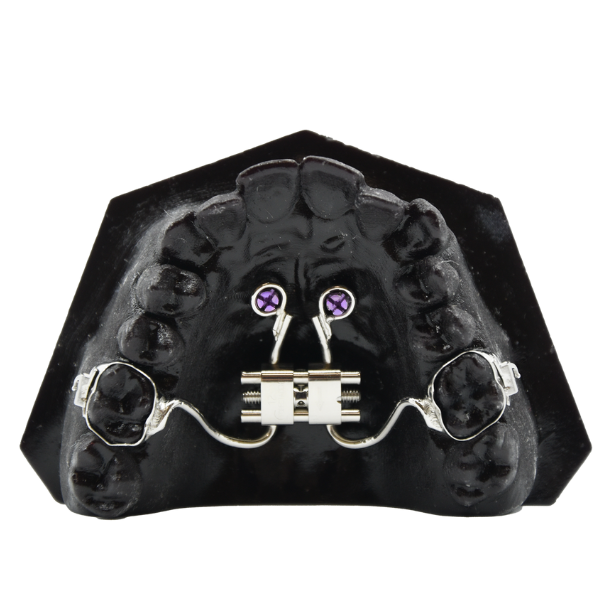
TAD-Based appliances feature incorporated temporary anchorage devices (TADs) to help provide a stable foundation for expander treatment.
https://neolab.com/tad-appliances/
How It Works
There are two main types of TAD-Based appliances, and each features a different workflow.
MSE (Maxillary Skeletal Expander). The MSE workflow is:
- Doctor takes a scan.
- NEOLab fabricates the appliance, ideally positioning the screw, which features four set placements for TADs. MES TADs must be used with this device; other TAD families are not supported.
- NEOLab ships appliance and 4 MSE TADs.
- Doctor receives the case, cements the appliance, and places the TADs.
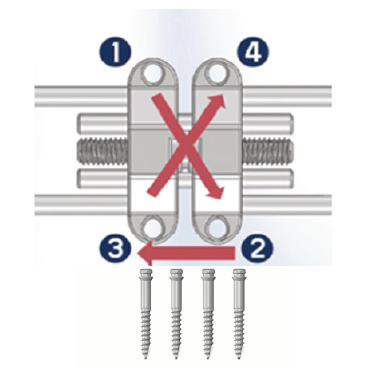
TAD-Supported RPE / MARPE. The TAD-Supported RPE standard workflow is:
- Doctor places TADs. Any TAD family is supported.
- Doctor takes scan.
- NEOLab fabricates the appliance, ideally positioning the screw, and building abutments to the already-placed TADs.
- NEOLab ships appliance.
- Doctor receives the case, cements the appliance, and affixes to TADs.
An alternative workflow is:
- Doctor takes scan.
- Doctor indicates position of intended TAD placement.
- NEOLab fabricates appliance, ideally positioning the screw, and building abutments for the planned-TADs.
- Doctor reviews and approves.
- NEOLab ships appliance. TADs provided if requested, but NEOLab only stocks MSE TADs.
- Doctor receives the case, cements the appliance, places the TADs, and affixes to the appliance.
What It Includes
There are two main types of TAD-Based appliances, and each include different things.
MSE (Maxillary Skeletal Expander). This appliance is ordered as a full kit:
- Expander appliance
- Expander key
- 4 MSE-specific TADs (billed separately)
TAD-Supported RPE / MARPE. This appliance is built to support TADs that have been or will be placed:
- Expander appliance
- Expander key
Who It's Meant For
TAD-Based expanders are used in patients who require additional anchorage to complete expansion. We often see TAD-based expanders used in patient populations who:
- Are older. Adult patients and patients reaching the end of their growth spurt have a fully formed palatal suture, which requires greater forces to expand.
- Have narrow palates. As with any expander, the MSE works to widen the upper jaw, making it an ideal choice for patients who have crossbite issues, narrow upper jaws, and/or impacted teeth.
- Have airway issues. TAD-Based appliances are gaining popularity for their ability to widen the airway, making breathing during sleep more consistent and reliable.
Who it's Not Meant For
TAD-Based appliances are not intended for patients who:
- Have severe palatal abnormalities (extremely thin palates)
- Have a history of facial trauma
- Have a degenerative bone-disease, or a strong family history of bone-disorders
How Does This Solution Fix My Problem?
TAD-Based appliances offer additional anchorage in many different appliance designs, and offer more deliberate control over certain areas of the mouth. TADs offer individual support, relieving pressure from surrounding teeth by providing a stable point of force application.
TAD-Based appliances offer bone extension in adult patients, which is traditionally difficult to achieve given the fusion of the palatal suture. Typically, adult patients can only achieve dental expansion (moving the teeth rather than expanding the jaw) without additional anchorage.
How to Order
New prescription coming soon.
Options
Doctors can add MSE TADs to their appliance order, if not already included.
Doctors can determine their own placement of TADs with TAD-supported options. If they would like a standard placement, doctors can opt for the MSE.
Files
In this section, find:
- TAD Promotional Flyer
Was this article helpful?
That’s Great!
Thank you for your feedback
Sorry! We couldn't be helpful
Thank you for your feedback
Feedback sent
We appreciate your effort and will try to fix the article